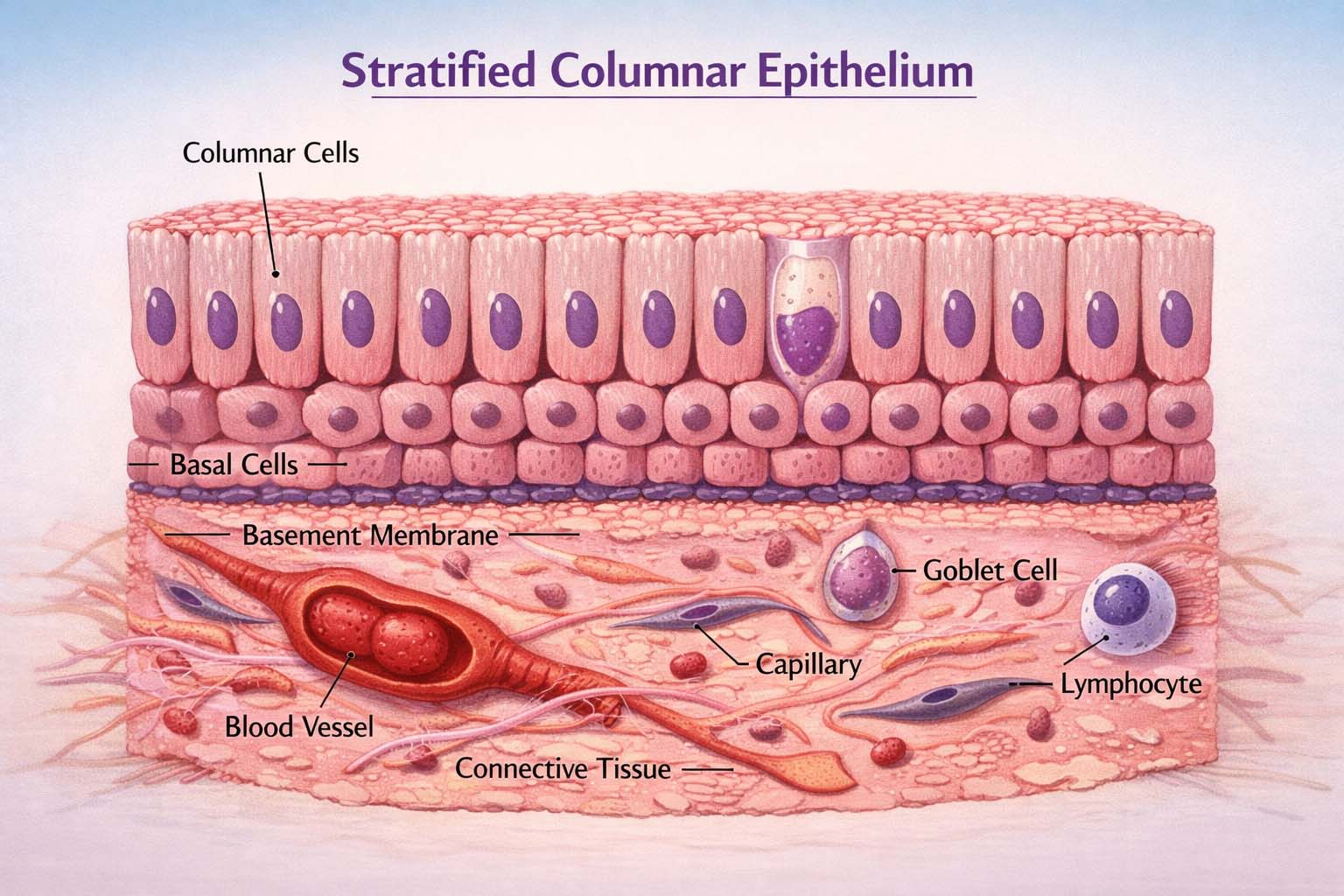
Stratified columnar epithelium is a rare but important type of epithelial tissue found in the human body. Epithelial tissues are responsible for covering body surfaces, lining internal organs, and protecting delicate structures. Among the many epithelial tissue types, stands out because it combines multiple cell layers with column-shaped surface cells.
This tissue is specially designed for protection and secretion. Although it is less common than simple squamous or stratified squamous epithelium, it plays a vital role in specific organs and ducts. Understandingessential for students of biology, anatomy, histology, and medicine.
What Is Stratified Columnar Epithelium?
Stratified columnar epithelium is an epithelial tissue made up of several layers of cells. The uppermost layer consists of tall, column-shaped cells, while the deeper layers are usually cuboidal or irregular in shape.
The word stratified means layered, and columnar refers to the tall rectangular appearance of the cells on the surface. This structure provides strength and protection while maintaining secretory abilities.
Unlike simple columnar epithelium, which has only one cell layer, s has multiple layers, making it more durable.
Structure of Stratified Columnar Epithelium
The tissue has a unique microscopic appearance that helps identify it in histology studies.
Main Structural Features:
- Two or more layers of cells
- Basal cells are cuboidal or irregular
- Surface cells are tall and columnar
- Cells rest on a basement membrane
- Connected tightly to form a protective barrier
Because of its layered arrangement, this tissue can resist wear and tear better than single-layer epithelium.
Functions of Stratified Columnar Epithelium
Stratified columnar epithelium performs several important tasks in the body.
1. Protection
Its multiple layers help protect organs and ducts from mechanical stress, friction, and minor injuries.
2. Secretion
The columnar cells at the surface may produce mucus or other fluids that lubricate tissues and ducts.
3. Support
It strengthens passageways that need both durability and specialized lining.
4. Barrier Role
Like all epithelial tissues, it forms a boundary between tissues and surrounding environments.
Location of StratifiedColumnar Epithelium
This tissue is rare, but it can be found in several specific areas of the body.
Common Locations:
- Large ducts of salivary glands
- Parts of the male urethra
- Conjunctiva of the eye
- Portions of the pharynx
- Some glandular ducts
Because these areas need both protection and secretion, stratified columnar epithelium is ideal.
Why Is Stratified Columnar Epithelium Rare?
Many body surfaces require either thin tissue for absorption or thick tissue for strong protection. offers a balance of both, so it is only needed in a few specialized regions.
That is why it is less common than:
- Simple squamous epithelium
- Simple cuboidal epithelium
- Simple columnar epithelium
- Stratified squamous epithelium
Its rarity makes it especially interesting in histology.
Difference Between Stratified Columnar and Other Epithelium
Stratified Columnar v Stratified Squamous
- Stratified columnar has tall surface cells
- Stratified squamous has flat surface cells
- Stratified columnar has multiple layers
- Simple columnar has a single layer
Stratified Columnar v Transitional
- Transitional epithelium changes shape when stretched
- Stratified columnar keeps its column-shaped surface layer
These comparisons help students identify tissue slides more easily.
Importance in Histology and Anatomy
In laboratory studies, stratified columnar epithelium is recognized under the microscope by its multiple layers and columnar surface cells. Histologists study it to understand tissue specialization and organ function.
Medical students also learn this tissue type because epithelial abnormalities may signal disease or inflammation.
Clinical Significance
Changes in stratified columnar epithelium can occur due to infection, irritation, or abnormal cell growth. Doctors may examine biopsy samples from ducts or urethral tissue to check for disease.
Because many cancers begin in epithelial tissues, understanding these cell types helps in pathology and diagnosis.
How to Remember Stratified Columnar Epithelium
A simple memory tip:
- Stratified = stacked layers
- Columnar = tall top cells
Think of several layers of bricks with tall pillars on top.
Quick Facts
- Rare epithelial tissue
- Found in gland ducts and male urethra
- Multiple protective layers
- Surface cells are column-shaped
- Helps with secretion and protection
Student Study Notes
When reviewing this tissue, focus on three things:
- Cell shape at the top
- Number of layers
- Body location
These clues make identification much easier during exams.
Conclusion
Stratified columnar epithelium is a unique and uncommon epithelial tissue with important protective and secretory functions. Its multiple layers provide strength, while the columnar surface cells help line specialized ducts and passageways.
Although rare, it is an essential topic in anatomy and histology because it demonstrates how tissue structure matches function. By learning where it is found and how it works, students gain a better understanding of the remarkable organization of the human body.