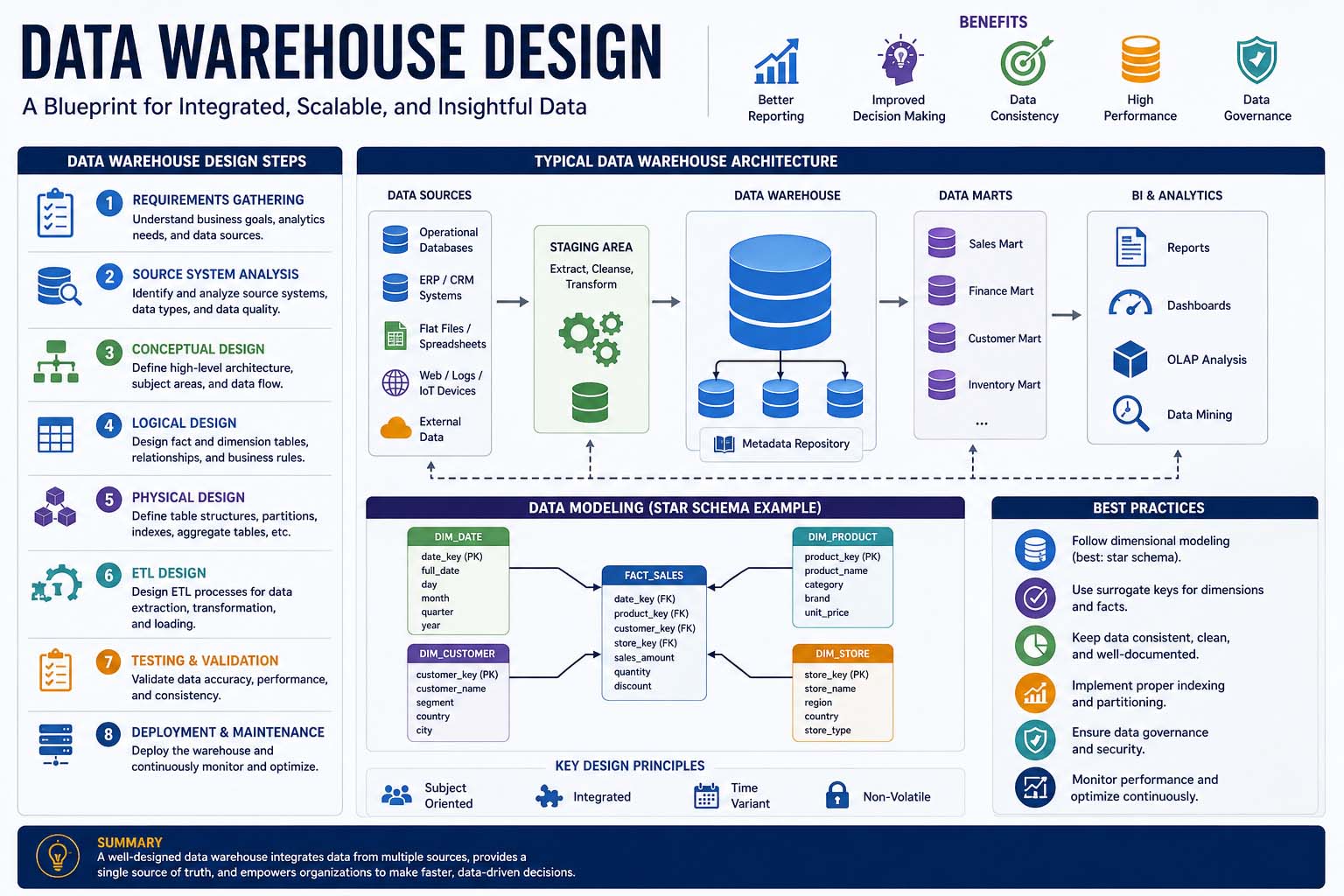
Data warehouse design is one of the most important parts of modern business intelligence. Companies generate massive amounts of information every day from sales, marketing, customer service, finance, and operations. Without a structured system, this data becomes difficult to manage and analyze. A well-planned design helps businesses organize information, improve reporting, and make smarter decisions based on accurate insights.
A data warehouse is a centralized system that stores data collected from multiple sources. Unlike traditional databases that focus on daily transactions, a data warehouse is designed for analytics, reporting, and long-term trend analysis. Effective data warehouse design ensures that the system is fast, scalable, secure, and easy to use.
What Is Data Warehouse Design?
Data warehouse design refers to the process of planning and building a structured repository for business data. It includes deciding how data will be collected, stored, organized, and accessed. The main goal is to create a system that supports analysis and decision-making.
When businesses use proper , they can combine information from different departments into one place. For example, sales data from an online store, customer support records, and marketing campaign results can all be integrated into a single system.
This unified approach helps teams gain a complete view of business performance.
Why Data Warehouse Design Matters
Many businesses struggle with scattered data stored across multiple applications. This creates confusion, delays, and inaccurate reporting. Good solves these problems by creating one trusted source of truth.
Benefits include:
Better Reporting
Reports become faster and more accurate when all data is stored in one system. Teams no longer need to manually combine spreadsheets or databases.
Improved Decision Making
Executives and managers can analyze trends, identify opportunities, and respond quickly to market changes.
Historical Analysis
A warehouse stores historical data over many years, making it easier to track long-term growth and performance.
Data Consistency
Proper data warehouse design ensures that definitions, metrics, and calculations remain consistent across the company.
Core Components of Data Warehouse Design
A successful warehouse includes several important components.
Data Sources
These are the systems where raw data originates. Examples include CRM tools, ERP systems, websites, mobile apps, and spreadsheets.
ETL or ELT Process
ETL stands for Extract, Transform, Load. Data is collected from source systems, cleaned, transformed, and loaded into the warehouse. Modern systems may also use ELT, where transformation happens after loading.
Storage Layer
This is where structured data is stored for analysis. Popular cloud platforms offer scalable warehouse storage solutions.
Semantic Layer
A semantic layer helps business users understand data through friendly terms such as revenue, customer count, or profit margin.
Reporting Tools
Dashboards and business intelligence platforms connect to the warehouse for analysis and visualization.
Types of Data Warehouse Design
Different businesses use different models depending on their needs.
Enterprise Data Warehouse
This is a company-wide system that integrates data across all departments. It is ideal for large organizations needing centralized analytics.
Data Mart
A data mart is a smaller version focused on one department such as finance, sales, or marketing.
Virtual Warehouse
This model provides access to data without fully storing all information in one place.
Best Practices for Data Warehouse Design
Creating a high-performing warehouse requires careful planning.
Understand Business Goals
Before building anything, identify the questions the business wants to answer. Design should support real business needs.
Use Scalable Architecture
Choose technology that can grow with increasing data volume and users.
Focus on Data Quality
Bad data leads to poor decisions. Include validation, cleaning, and governance processes.
Optimize Performance
Use indexing, partitioning, and efficient queries to improve speed.
Ensure Security
Protect sensitive information with role-based access, encryption, and compliance controls.
Document Everything
Maintain clear documentation for tables, metrics, processes, and business definitions.
Star Schema vs Snowflake Schema
Two common modeling approaches are used in data warehouse design.
Star Schema
This model uses one fact table connected to multiple dimension tables. It is simple, fast, and easy for reporting.
Snowflake Schema
This design normalizes dimension tables into smaller related tables. It reduces redundancy but can be more complex.
Many organizations choose the star schema for simplicity and performance.
Steps to Build a Data Warehouse
The process usually follows these stages.
Requirement Gathering
Meet stakeholders and understand reporting needs.
Data Source Identification
List all systems providing useful data.
Data Modeling
Create fact and dimension tables.
Build ETL Pipelines
Automate data extraction and transformation.
Testing
Verify data accuracy, performance, and security.
Deployment
Launch the warehouse and connect dashboards.
Maintenance
Continuously improve based on feedback and changing business needs.
Common Challenges in Data Warehouse Design
Even good projects face challenges.
Poor Requirements
If goals are unclear, the system may not deliver value.
Data Silos
Departments may resist sharing information.
Performance Issues
Large datasets require optimization.
Changing Business Needs
Reports and metrics often evolve over time.
Strong planning and communication help overcome these obstacles.
Future of Data Warehouse Design
Modern warehouses are moving to the cloud, offering faster setup, lower maintenance, and better scalability. Businesses now combine structured and unstructured data, use real-time analytics, and apply machine learning directly within warehouse platforms.
This means data warehouse design is becoming more strategic than ever before.
Conclusion
Data warehouse design is essential for organizations that want to turn raw information into valuable insights. A well-designed warehouse improves reporting, supports smarter decisions, and creates a reliable source of truth for the entire business. By focusing on scalability, data quality, security, and business goals, companies can build a system that drives growth for years to come. Whether small or large, every modern business can benefit from strong data warehouse design principles.