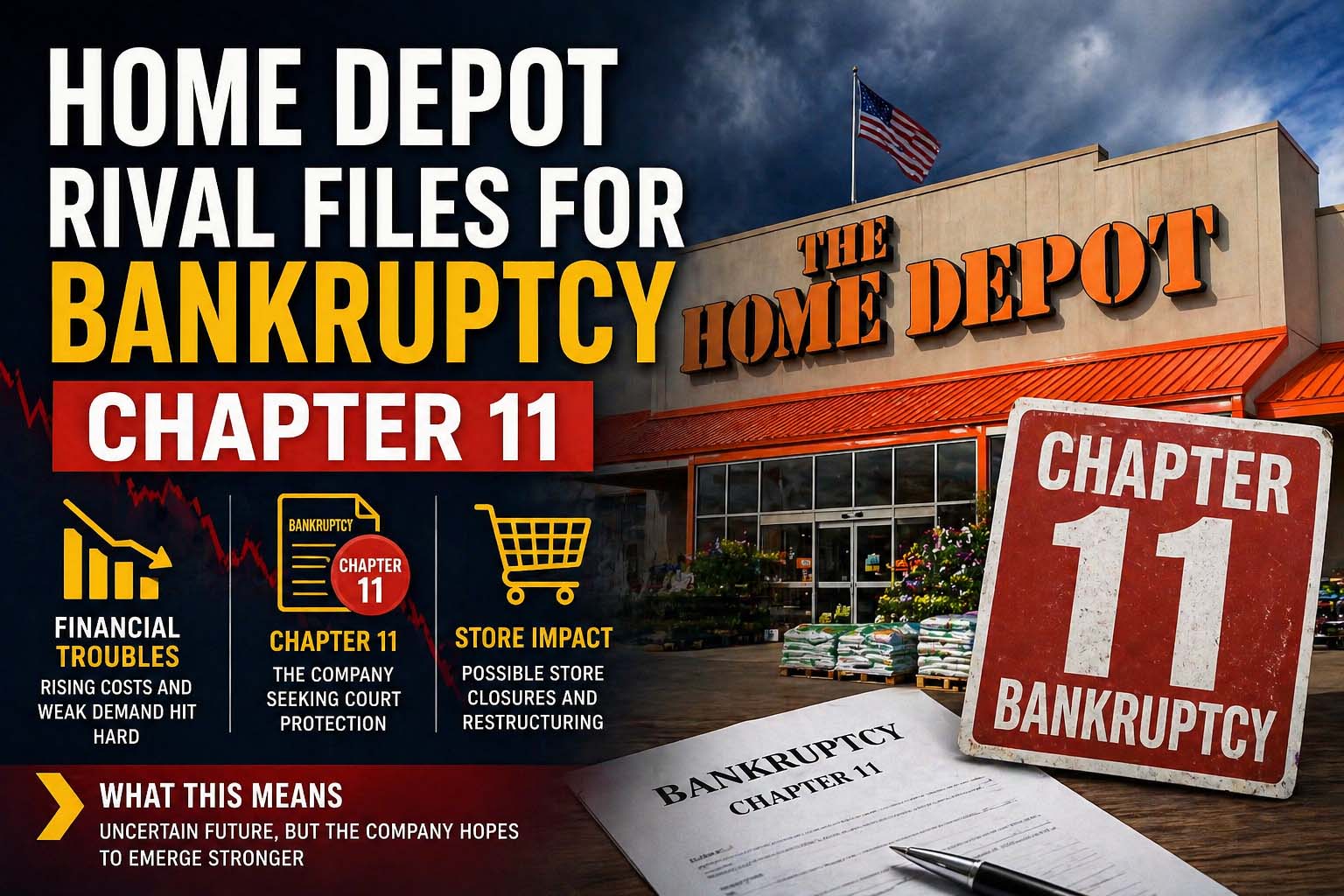
The home improvement retail sector is once again under pressure as a Home Depot rival files for Chapter 11 bankruptcy, highlighting ongoing financial strain among home depot rival files for bankruptcy chapter 11-sized suppliers competing in a market dominated by giants like Home Depot and Lowe’s. Recent filings show how inflation, rising interest rates, tariffs, and shifting consumer demand are reshaping the industry landscape.
A Growing Trend of Retail Distress
Over the past few years, several home improvement and building materials companies have turned to Chapter 11 protection to survive. This legal process allows businesses to continue operating while restructuring debt and negotiating with creditors instead of shutting down completely.
In one recent case, North American Builder’s Supply (NABS)—a regional competitor often described as a Home Depot rival—filed for Chapter 11 in late 2025. The company cited financial pressure from rising material costs, supply chain disruptions, and weaker demand in the housing sector as key reasons for the filing.
This is not an isolated event. Multiple suppliers and retailers in the home improvement space have faced similar challenges, with some forced to close stores or sell assets to survive.
Why These Companies Are Struggling
Several factors are driving this wave of bankruptcy filings among Home Depot rivals:
1. Market dominance of big-box retailers
Home Depot, Lowe’s, and Amazon together control the majority of consumer spending in home improvement, leaving smaller competitors with limited market share.
2. Rising construction costs
Higher lumber prices, tariffs, and inflation have increased building costs, reducing demand from both contractors and DIY customers.
3. Slowing housing and renovation demand
After the pandemic boom in home renovation, consumer spending has cooled, especially as interest rates remain high.
4. Heavy debt loads
Many regional retailers expanded aggressively during stronger economic periods and are now struggling to service debt amid declining revenue.
What Chapter 11 Means in Practice
Filing for Chapter 11 does not necessarily mean a company is shutting down. Instead, it allows businesses to:
- Continue operating stores or services
- Renegotiate debt with creditors
- Close underperforming locations
- Seek new investors or buyers
In many cases, companies emerge smaller but financially healthier. However, not all recover successfully—some eventually move from Chapter 11 to liquidation if restructuring fails.
Impact on the Industry
When a Home Depot rival files for bankruptcy, the ripple effects are wide:
- Suppliers face unpaid invoices or delayed payments
- Employees may experience layoffs or store closures
- Customers may see reduced product availability
- Competition decreases, strengthening major retailers’ dominance
Industry analysts note that the consolidation trend is accelerating, with larger chains capturing an increasing share of the market while smaller players struggle to survive.
The Bigger Picture
The repeated wave of bankruptcies among home improvement rivals signals a structural shift in the industry. The combination of economic pressure and intense competition is making it difficult for mid-sized companies to remain viable.
While Chapter 11 offers a path to survival, it also often marks a turning point—where companies must radically restructure or shrink to adapt to a more competitive and cost-sensitive market.
Conclusion
A Home Depot rival filing for Chapter 11 bankruptcy is no longer an isolated headline—it is part of a broader transformation in the home improvement industry. As economic pressures continue and market power concentrates among a few dominant players, smaller retailers must innovate or restructure to stay in the game.